






Weekly Market Insights: Santa Brings Joy For The DJIA
- Category: Blog
Stocks posted solid gains in an action-packed week of market-moving economic data, geopolitical news, and bullish new year sentiment.
The Standard & Poor’s 500 Index gained 1.57 percent, while the Nasdaq Composite Index added 1.88 percent. The Dow Jones Industrial Average rose 2.32 percent. The MSCI EAFE Index, which tracks developed overseas stock markets, advanced 1.41 percent.1,2
Santa Visits Dow, But Not S&P, Nasdaq
Stocks rose early Monday, led by the Dow Industrials, as investors looked past the news from Venezuela.
By Monday’s close, the Dow Industrials had gained enough to make the “Santa Claus Rally” a reality, pushing the Average to a 1.1 percent gain for the seven-session period (the last five trading days of 2025 and the first two of 2026). However, the S&P and Nasdaq came up short.3
All three major averages continued their rise through midweek as the AI trade—led by chip manufacturers—helped momentum. The Dow Industrials crossed the 49,000 level for the first time, and both the S&P 500 and Dow hit record closes as well as all-time intraday highs.4
The Dow then moved back into the “pole position” over the next session as investors appeared to rotate out of technology stocks and into other sectors, including cyclical stocks. Defense stocks got a boost from the president’s call for a $1.5 trillion annual defense budget in 2027—higher than the Pentagon’s target.5,6
The December jobs report, released on Friday, showed modest job gains and a slight decline in the unemployment rate. Investors cheered the news, believing the update gave the Fed some flexibility with rates at its January meeting.7

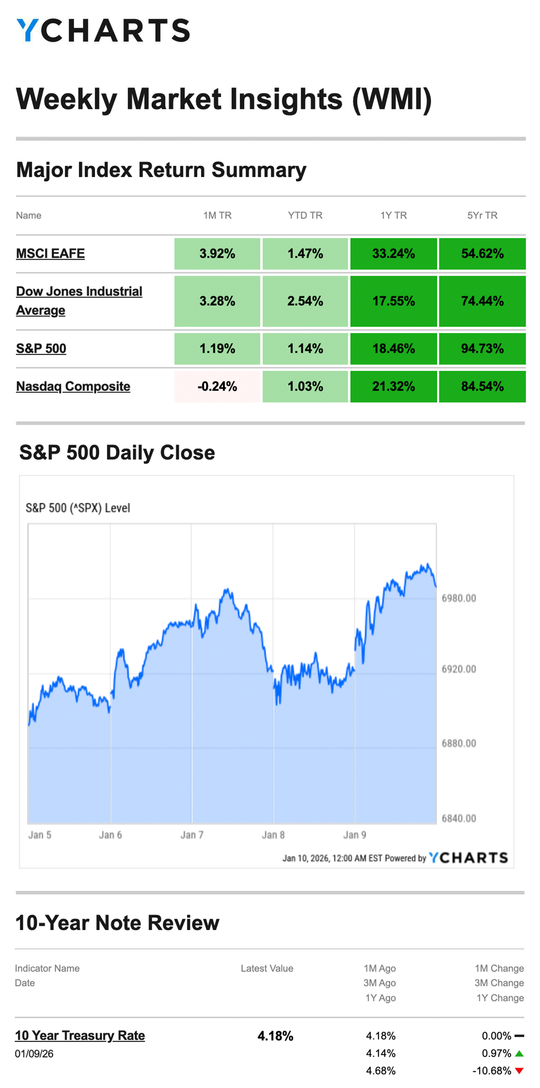
Source: YCharts.com, January 10, 2026. Weekly performance is measured from Monday, January 5, to Friday, January 9. TR = total return for the index, which includes any dividends as well as any other cash distributions during the period. Treasury note yield is expressed in basis points.
Jobs Report
The Labor Department’s latest employment report showed a net gain of 50,000 jobs last month while unemployment ticked down to 4.4 percent, missing economists’ expectations of 73,000 jobs.7
Over the full year, net job growth averaged 49,000 per month—the lowest monthly pace in 22 years and a drop from 168,000 per month in 2024. Federal job cuts were a primary reason for the sluggish labor market in 2025, with 277,000 government positions eliminated.7
This Week: Key Economic Data
Monday: Fed Presidents Tom Barkin (Richmond), Raphael Bostic (Atlanta), and John Williams (New York) speak.
Tuesday: NFIB Small Business Optimism Index. Consumer Price Index (CPI). New Home Sales* (Oct). Fed Presidents Alberto Musalem (St. Louis) and Barkin (Richmond) speak. Federal Budget Deficit.
Wednesday: Retail Sales* (Nov). Producer Price Index (PPI)* (Nov). Business Inventories* (Oct). Existing Home Sales. Federal Reserve’s Beige Book. Fed Presidents Neel Kashkari (Minneapolis), Bostic (Atlanta), and Williams (New York) speak. Fed Governor Stephen Miran speaks.
Thursday: Weekly Jobless Claims. Import Prices* (Nov). Fed Governor Michael Barr and Fed Presidents Jeff Schmid (Kansas City) and Barkin (Richmond) speak.
Friday: Industrial Production. Capacity Utilization. Fed Vice Chair Philip Jefferson and Fed President Barkin (Richmond) speak.
* indicates publication of a report delayed by the government shutdown in October and November
Source: Investors Business Daily - Econoday economic calendar; January 9, 2025. The Econoday economic calendar lists upcoming U.S. economic data releases (including key economic indicators), Federal Reserve policy meetings, and speaking engagements of Federal Reserve officials. The content is developed from sources believed to provide accurate information. The forecasts or forward-looking statements are based on assumptions and may not materialize. The forecasts are also subject to revision.
This Week: Companies Reporting Earnings
Tuesday: JPMorgan Chase & Co. (JPM), The Bank of New York Mellon Corporation (BK), Delta Air Lines, Inc. (DAL)
Wednesday: Bank of America Corporation (BAC), Wells Fargo & Company (WFC), Citigroup Inc. (C)
Thursday: Morgan Stanley (MS), The Goldman Sachs Group, Inc. (GS), BlackRock (BLK), Infosys (INFY)
Friday: The PNC Financial Services Group, Inc. (PNC)
Source: Zacks, January 9, 2025. Companies mentioned are for informational purposes only. It should not be considered a solicitation for the purchase or sale of the securities. Investing involves risks, and investment decisions should be based on your goals, time horizon, and risk tolerance. The return and principal value of investments will fluctuate as market conditions change. When sold, investments may be worth more or less than their original cost. Companies may reschedule their earnings reports without notice.

"It has always been easy to hate and destroy. To build and to cherish is much more difficult."
– Queen Elizabeth II

Tax Benefit and Credits: FAQs for Retirees
Many questions can arise about income taxes after retirement. Listed are answers to just a few common questions from retired taxpayers.
What types of income are taxable?
Some common types of taxable income include all or part of pension and retirement account income, gambling income, and alimony or prizes.
What types of income are non-taxable?
A few examples of non-taxable income include veterans’ benefits, disability pay for specific military or government-related incidents, workers’ compensation, and cash rebates from a dealer or manufacturer of an item you have purchased.
Why is my pension taxed?
It may depend on how the money was put into the pension. For example, if the money was not taxed before going into the plan, it may be taxable. Conversely, if your contribution is from already-taxed dollars, that portion of the pension may not be taxed.
This information is not a substitute for individualized tax advice. Please consult with a qualified tax professional to discuss your specific tax issues.
Tip adapted from IRS.gov8

Practicing Gratitude
Psychologists have defined gratitude as a positive emotional response to receiving a benefit from someone or something. In positive psychology, gratitude is the human way of acknowledging the good things in life. Thankfully, you can learn gratitude if it does not come innately.
Practicing gratitude offers numerous benefits, particularly during times of stress and uncertainty. Gratitude invites positive emotions that can have physical benefits through the immune or endocrine systems. Research shows that when we reflect on what we appreciate, the parasympathetic or calming part of the nervous system is triggered, which can have protective benefits for the body—including decreasing levels of the stress hormone cortisol and increasing oxytocin, the hormone involved in relationships that fosters feelings of well-being.
There are a few great ways to get started today and practice gratitude in your own life:
- Write thank you notes
- Keep a gratitude journal
- Follow up with family and friends
- Give back to your family, friends, and community
- Pay kindnesses forward
Tip adapted from Mindful.org9

You can separate them with a word, yet they are mostly inseparable. What are they?
Last Week's Riddle: What starts with P and ends with E and has thousands of letters in it?
Answer: Post Office.


Niterói
Rio de Janeiro, Brasil
Footnotes And Sources
- WSJ.com, January 9, 2026
- Investing.com, January 9, 2026
- CNBC.com, January 5, 2026
- CNBC.com, January 6, 2026
- CNBC.com, January 7, 2026
- WSJ.com, January 8, 2026
- CNBC.com, January 9, 2026
- IRS.gov, August 18, 2025
- Mindful.org, August 25, 2025